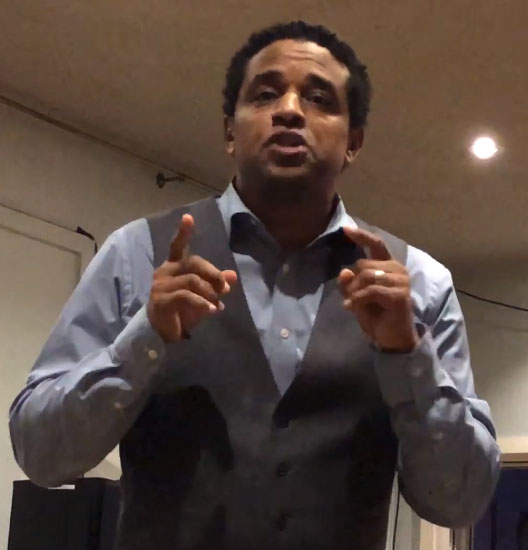
At the beginning of the December 20th, 2018 all paid and unpaid staff meeting many staff criticized the disrespectful and non-collaborative way local WBAI management has made program changes at the station. Management gave the “ad hoc Producers and Friends” committee 10 minutes to express our views. New Pacifica Executive Director Maxie Jackson presided over the slide show and remainder of the meeting. Many of us expressed our view that the manner of changes is a violation of Pacifica’s mission. Text of our remarks follow the video below in which Maxie Jackson, the new executive director of Pacifica, addresses WBAI’s unpaid and paid staff discussing his “Strip Programming” philosophy. He outlines his goal is that eventually that the 6am-6pm weekday slots be by 1 host across the week. He says that his approach is “data driven” but only cited Neilsen (formerly Arbitron) Ratings as the data from which conclusions are drawn.
Statement to WBAI and Pacifica Management
by Ad Hoc Group of Staff and Friends of WBAI
Dec. 20, 2018
We have requested agenda space in this meeting to address our concerns regarding the programming direction currently proposed for WBAI.
It is obvious to most that steps need to be taken to increase our listenership, which has a direct bearing on our operating revenue. However, we are alarmed about the direction that management’s proposals are taking us, and the complete exclusion of staff and community participation in the analysis and decision-making process that led to these proposals. We are equally alarmed that the proposed changes, rationalized by the desire “to increase our listener numbers” have, in effect, given rise to a racial, gender, and ethnic gentrification of the broadcast schedule, giving a majority of the prime airtime to white males in a metropolitan area whose majority consists of people of color and women.1
Nevertheless, your stated basis for instituting these changes is the metrics obtained from the Nielsen ratings, which are primarily designed for commercial media and have been shown to be racially and culturally biased as to the demographic communities and communities of interest they actually survey.
It is not WBAI’s programming, nor its producers, who are at fault for audiences drifting away, and with them the weakening of our revenue stream. Rather it is management’s ineptitude and refusal to embrace its producers, who for years now have brought to its attention various fund-raising proposals, developed in conjunction with non-profit fundraising experts. The greatest listener killer has been the incessant on-air fund drives. Management has now created the formula for ever longer drives, 135-140 days of fundraising a year (37%), which produce ever-lower revenue and pre-empt the vast majority of all programming. It’s well known in public radio that fund-drives reduce listenership by up to 50%. With the current formula, listenership never recovers by the time a new fund drive starts.2 Management needs to seek or obtain outside funds, philanthropic and otherwise, as well as other professional collaborations that could remedy the situation.
We believe that the announced changes violate the Pacifica By-Laws (Article 7, Section G), requiring “that station policies and procedures for making programming decisions and for program evaluation are working in a fair, collaborative and respectful manner to provide quality programming.” The changes also abrogate the Pacifica mission statement, which states, in part, that among the Foundation’s purposes are:
“…[to] contribute to a lasting understanding between nations and between the individuals of all nations, races, creeds and colors; to gather and disseminate information on the causes of conflict between any and all of such groups; and through any and all means compatible with the purposes of this corporation to promote the study of political and economic problems and of the causes of religious, philosophical and racial antagonisms.”
“In radio broadcasting operations to promote the full distribution of public information; to obtain access to sources of news not commonly brought together in the same medium; and to employ such varied sources in the public presentation of accurate, objective, comprehensive news on all matters vitally affecting the community…”
Pacifica has sustained this mission for more than 6 decades. And Pacifica should remain a progressive institution in the broad and nonsectarian sense Lewis Hill intended. We stand against attempts to circumscribe political debate within the ideological and institutional framework of the dominant two-party system, opting instead to present the perspective of dissident thinkers and groups absent from the mainstream media. We hold firm to the concept that our air should provide a venue for the full range of American cultural life. In a word, Pacifica should continue to resist the shrinking of the public sphere, the decline of sites where citizens can engage in an open dialogue, exchange information and organize themselves.
Pacifica is distinct from National Public Radio, and cannot be permitted to devolve into the liberal wing of public and community radio. Indeed, Pacifica’s mission is to go where others fear to tread, to raise issues outside the established framework of discourse, placing it at odds with mainstream liberalism.
Pacifica should examine and expand its listenership without mimicking the way commercial and public radio stations make ratings the measure of success. We have seen National Public Radio grow larger and become less diverse and vital than it was 25 years ago. Pacifica, as an independent institution engaged in groundbreaking programming, has wielded significant influence through a complex process of diffusion of information and ideas to primary and secondary audiences. That influence cannot be measured simply in terms of Nielsen’s “cumes” of audience statistics. It would be relatively easy to increase listenership of targeted audiences through popular programming stratagems not in keeping with Pacifica’s mission.
It is an illusion that Pacifica can achieve mainstream popularity and continue to be a critical voice in broadcast journalism. A quest for audience growth for its own sake flies in the face of Pacifica traditions, suggests the acceptance of a more traditional paradigm, and threatens to erode Pacifica’s historic mission. “Strip programming” and rating charts as the ultimate determinant eviscerate the very reason Pacifica/WBAI came into existence.
We strongly object to the fact that there has been no inclusive process by management, no fair evaluation, no use of a diverse program advisory committee of producers, or focus groups from core listeners and communities whose voices yearn for outlets for expression.
Numerous show hosts have been terminated by cursory emails, some are left to wonder if they were terminated by omission from the relevant email. In some cases WBAI Management has stated that it want to get rid of hosts merely because they are too old and instead want Millennial hosts. All of this is being done in a very hurried manner where the Interim Program Director sometimes wants answers about whether producers will accept a time slot by saying take-it-or-leave-it on less than a day’s notice. Some talk show hosts have been moved to new slots and then downsized, again reaping criticism about poor ratings after only 3 weeks in their new time slots.
Meanwhile, management has hired and put on WBAI’s airwaves a disgraced male host, fired from WNYC for “inappropriate conduct” subsequent to complaints of 4 female staff members without consultation with staff at WBAI, a decision that caused several six producers to remove themselves from WBAI’s airwaves in protest.
What We Want From WBAI Management:
1. Roll back programming changes beginning with the introduction of Leonard Lopate into the 1 p.m. slot.
2. Cease and desist programming changes without advice and consent from the producing staff.
3. Institute a fair process, with objective criteria for proposed program changes and adding new programs, including the following:
• review by a producers’ advisory committee
• discussion between the IPD and the affected producer(s) regarding community relevance, audience building, outreach, fundraising, etc.
• management’s provision of technical assistance and resources for enhancing program production;
4. Cooperate with a producers’ advisory committee in convening listener focus groups for programming needs and soliciting pilots for new programming based on that input;
5. Work with a group of nonprofit fundraising professionals for WBAI to diversify its fundraising and provide greater accountability and transparency.
WBAI and Pacifica have a unique potential to place issues on the national agenda and connect the progressive community with that agenda. Development of a strategy for realizing our mission under current conditions could be the focus of a Pacifica/WBAI summit on programming.
We believe that a good-faith effort by all the parties at WBAI to address the future of governance and programming, rooted in an understanding of its unique historic mission, will help unify and revitalize WBAI.
We are calling on the new Executive Director of Pacifica and WBAI management to immediately place a hold on all changes, while directing funds (that would have paid new producers) to initiate a publicity campaign, in the subways, etc. throughout the metro area to let the DIVERSE communities know that this station exists and is ready to serve their broadcast needs. We ask the question: Is management trying to attract the new gentrified population spreading across New York City? Or is our mission still to combat such practices and partake in the fight against widespread displacement? What is our mission in the 21st century?
************
NOTES
1. Census data for New York Metropolitan area, 2018
https://www.census.gov/quickfacts/ny
White (not Hispanic/Latino) 55.3%
Hispanic or Latino 19.2%
Black or African American 17.7%
Asian 9.1%
American Indian 1.0%
Native Hawaiian and Other Pacific Islander: 0.1%
Two or more races 2.5%
2. For example, most recently we had a mere 4 weeks of programming, which interrupted what has now been 7 ½ weeks of fundraising.